JOHN G. TENNENT, III, CDR, USN
John Tennent, III '32
Lucky Bag
From the 1932 Lucky Bag:

JOHN GARDNER TENNENT, 3rd
Fredericksburg, Virginia
"Jack"
When John, alias Jack, cut his first teeth on the ornamented buckle of his father's sword belt, the Gods winked knowingly and said among themselves, "We'll send him to Annapolis." Various trials and tribulations were encountered in the interim between cradle days and the summer of 1928, but according to prediction, Jack became one of us, a Plebe in a voluminous suit of white works and a white hat that tired his ears.
The fight with academics began in October and since then studies have offered no little opposition to Jack's ambitions, but nothing daunted, he has surmounted all obstacles and, by perseverance, has maintained his head above the academic sea.
A sunny disposition, a desire to please, and a ready smile have made Jack a valued member of our class and they have helped to make our lives a little more cheerful. A detailed account of his qualities would be too lengthy, so suffice it to say that he has been a classmate of whom we are proud. What more could you say of any man?
Water Polo; Reception Committee; Plebe Lacrosse; 2 P. O.
JOHN GARDNER TENNENT, 3rd
Fredericksburg, Virginia
"Jack"
When John, alias Jack, cut his first teeth on the ornamented buckle of his father's sword belt, the Gods winked knowingly and said among themselves, "We'll send him to Annapolis." Various trials and tribulations were encountered in the interim between cradle days and the summer of 1928, but according to prediction, Jack became one of us, a Plebe in a voluminous suit of white works and a white hat that tired his ears.
The fight with academics began in October and since then studies have offered no little opposition to Jack's ambitions, but nothing daunted, he has surmounted all obstacles and, by perseverance, has maintained his head above the academic sea.
A sunny disposition, a desire to please, and a ready smile have made Jack a valued member of our class and they have helped to make our lives a little more cheerful. A detailed account of his qualities would be too lengthy, so suffice it to say that he has been a classmate of whom we are proud. What more could you say of any man?
Water Polo; Reception Committee; Plebe Lacrosse; 2 P. O.
Loss
John was killed in action on January 30, 1944 when USS Anderson (DD 411) was struck by artillery fire from Wotje Atoll in the Marshall Islands chain. He was the ship's commanding officer.
From Wikipedia:
Battle of Kwajalein
By 21 December 1943, [USS Anderson] was back in San Diego to escort the 4th Marine Division to Kwajalein. En route, Anderson was one of the units designated to conduct a diversionary strike at Wotje on 30 January 1944. As one of the leading destroyers she opened the bombardment at 0642 and began to maneuver to avoid enemy return fire. At 0646, a shell hit in her combat information center (CIC), killing the commanding officer, Lieutenant Commander John G. Tennent, III, two ensigns, and three enlisted men, and wounding 14 others.
John had been in command of Anderson since May 14, 1943.[1]
Other Information
From researcher Kathy Franz:
John was born in Washington, D. C. He was engaged to Virginia Dawes in June, 1932. She was the daughter of the former vice president General Charles Gates Dawes.
On January 26, 1935, in San Francisco, John married Barbara Josephine Carpenter.
In April 1937, John was ordered to the USS Oglala, and in August, John sailed from Honolulu to San Francisco.
John was ordered to the USS Nitro on January 14, 1939, but two weeks later the order was revoked.
In March 1941, John was assigned to be executive officer of the USS Dorsey.
John married Mrs. Louise Brooks Howard on July 12, 1941, in Green Springs, Maryland. She was the daughter of Mrs. Lionel Atwill, former wife of General Douglas MacArthur. Louise’s former husband William Ross Howard, III, married screen actress Dorothy Lamour.
John’s father was Captain Eugene Hunter Tennent, USN. His mother was the former Roberta Louise Durrett.
From Heroes of the United States Naval Academy:
As commanding officer of USS Southard (DMS 207) CDR Tennent was involved in a 8 hour deadly struggle with Japanese submarine I 15, off Guadalcanal that resulted in the dramatic sinking of the Japanese submarine. Later, unfortunately revenge was had when a Japanese shell pierced the CIC of his next ship, USS Anderson (DD 411) killing him and five other crew members.
John Gardener Tennent III was born on December 10, 1909, in Washington D.C. to Captain Eugene Hunter Tennent and Mrs. Roberta Louise (Durrette) Tennent. On June 14, 1928, he entered the United States Naval Academy as a Midshipman. Midshipman Tennent graduated 394 of 422 Midshipmen on June 2, 1932.
On June 30, 1932, Ensign Tennent was assigned to heavy cruiser USS Salt Lake City (CA 25).
By January 1, 1933, Ensign Tennent was assigned to heavy cruiser USS Portland (CA 33).
On January 26, 1935, Ensign Tennent married Miss Barbara Josephine Carpenter in San Francisco.
By July 1, 1936, LTJG Tennent was assigned to light destroyer minelayer USS Gamble (DM 15).
By April 1937, LTJG Tennent was assigned to minelayer USS Oglala (CM 4).
On September 8, 1937, LTJG Tennent divorced from his first wife Barbara.
By September 1937, to May 1939, LTJG Tennent was assigned to destroyer USS Dahlgren (DD 187).
On June 14, 1939, LTJG Tennent was assigned as an instructor in the Navigation Department as at the United States Naval Academy.
On April 17, 1941, Lieutenant Tennent was assigned as Executive Officer of destroyer minesweeper USS Dorsey (DMS 1).
On July 12, 1941, LCDR Tennent married Louise (Brooks) Howard in Green Springs, Maryland.
From September 29, 1942, to May 14, 1943, Lieutenant Commander Tennent was Commanding Officer of destroyer minesweeper USS Southard (DMS 207).
When the beachhead on Guadalcanal had been successfully established, Southard settled down to the risky routine of screening the convoys from New Caledonia and the New Hebrides to the Solomons. For almost eight months, she steamed back and forth between Espiritu Santo, Efate, Noumea, Tulagi, Purvis Bay, and Guadalcanal. There were frequent air attacks, and submarines prowled the sea lanes.
In the evening of November 9, 1942, Japanese submarine I 15 surfaced as usual well after dark off Cape Rechereche to recharge her batteries and make herself available to support any seaplane operations in the area. I 15 was still operating on the surface when her large outline was spotted by lookouts aboard the Guadalcanal bound highspeed destroyer minesweeper USS Southard at 0230 hours. Likely unaware of the American ship's presence in the darkness, the sudden sound of gunfire and several fountains of water rising around the I 15's hull as the Southard opened fire caused Commander Nobuo Ishikawa to order I 15 into a crash dive to escape her onrushing attacker.
On encountering an enemy submarine 3,000 yards on the surface, Southard immediately slowed to 10 knots and opened fire. The submarine submerged, and Southard commenced her first depth charge attack.
Successfully bringing his submarine out of the line of fire and into a position I 15 fired two torpedoes at the Southard, Commander Ishikawa's shots sailed wide of the Southard, which then ran down the slow moving I 15 and dropped several strings of depth charges onto her position, heavily damaging the submarine but not causing her to sink. Directing onboard salvage efforts in total silence as Commander Ishikawa maneuvered the I 15 away from several attacks by the Southard over the next several hours.
Southard lost contact with her adversary and did not regain it again until 0607, almost three and one half hours later. Over the next three hours, Southard made five more depth charge runs. After the last barrage, oil was sighted on the surface; and she moved in to investigate. Upon reaching the slick, Southard's crew could find no further evidence of damage, and she steamed on through the slick.
Commander Ishikawa and his crew did their best to elude their attacker but by 1000 hours onboard leaks had grown unmanageable, and the boats’ batteries were running low on power. Left few options, I 15's skipper ordered the ship to surface in the hopes of making a stand with her deck gun while using her still available high speed and potent torpedoes to damage, destroy or escape the Southard. Blowing her ballast tanks and breaking the surface at 1003 hours, the I 15 found herself roughly a mile distant from the USS Southard and unable to settle properly on the surface due to depth charge inflicted hull damage.
When Southard reached a point about 2,000 yards on the other side of the slick, the I 15 surfaced almost vertically exposing her whole conning tower, her hull forward of the conning tower, and part of her keel. Then the bow dropped about 10 degrees, and unable to maintain buoyancy the submarine slid rapidly by the stern and plunged uncontrollably to the ocean floor with the loss of all 92 hands.
Following a liberty and recreation excursion to Brisbane, Australia, and six days in dry dock at Sydney, Southard returned to patrol and convoy duty in early January 1943. On March 20, 1943, she stood out of Noumea in company with USS Hovey (DMS 11), USS Stringham (APD 6), and USS Sonoma (AT 12) towing USS Aulick (DD 596). This task unit stopped at Suva Harbor, Fiji, on the 25th and departed the next day to continue to Pago Pago, Pearl Harbor, and ultimately to San Francisco. Southard entered the Mare Island Navy Yard on April 19, 1943.
On May 14, 1943, Commander Tennent was Commanding Officer of destroyer USS Anderson (DD 411).
From April 9, 1943, to June 8,1943, Anderson lay at San Francisco undergoing overhaul and repairs. Following an escort run to Pearl Harbor and back in June 1943, Anderson departed San Francisco on July 11, 1943, with TG 96.1 enroute to Kodiak, Alaska, arriving on the 21st. Joining TG 16.17 on July 30, 1943, she participated in bombardments of Kiska on August 2, 1943, and August 15, 1943. Anderson remained in the Aleutians on patrol duty until September 21, 1943, when she departed for Pearl Harbor.
From October 14, 1943, to November 1, 1943, Anderson lay at Wellington, New Zealand, staging with the transports for the next operation. With TF 53, she arrived at her objective on November 19, 1943, Tarawa. As a part of Fire Support Group No. 3, she took station off the eastern end of Betio on D day, November 20. 1943, and began conducting bombardments of assigned targets. Betio was captured by the 24th, but Anderson remained in the general area on radar picket patrol and rendered intermittent call fire until November 29, 1943, when she departed for Pearl Harbor.
By December 21, 1943, Anderson was back in San Diego to escort the Fourth Marine Division to Kwajalein. Enroute, Anderson was one of the units designated to conduct a diversionary strike at Wotje on January 30, 1944. As one of the leading destroyer she opened the bombardment at 0642 and began to maneuver to avoid enemy return fire.
At 0646 on January 30, 1944, Commander Tennent was killed in action when Anderson was struck by artillery fire from Wotje Atoll in the Marchall Islands chain. Anderson was hit in the combat information center (CIC) by a shell. In all, six crewmen were killed in action, and 14 wounded. He was posthumously awarded the Legion of Merit with Combat “V” and Purple Heart. Others killed and posthumously awarded the Purple Heart were two Ensigns Robert William Carlin, USNR and Ensign John McClelland Entrikin, USNR. Three enlisted were killed and posthumously awarded the Purple Heart: Seaman 1c Leonard Link, USNR, Seaman 2c Wendell Rolfe, and Radioman 3c John Joseph Weiss, Jr.
Anderson’s executive officer immediately assumed command and kept her firing until she could maneuver to seaward to act as antisubmarine screen until completion of the Wotje bombardment at noon. The next day Anderson approached the objective islands of Roi and Namur, Kwajalein Atoll, and screened to seaward as the heavy units began the bombardment. On February 1, 1944, while transferring her wounded, she struck an uncharted pinnacle and had to be towed to Pearl Harbor.
His wife was listed as next of kin. John's name is in the Courts of the Missing in Hawaii.
Photographs
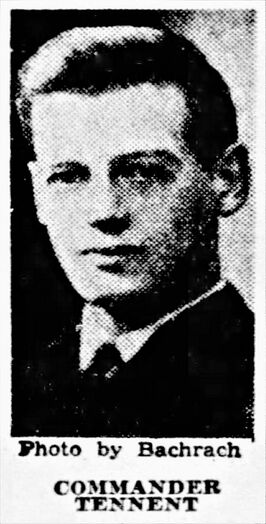
From The Philadelphia Inquirer on February 23, 1944

From Hall of Valor:
The President of the United States of America takes pleasure in presenting the Navy Cross to Lieutenant Commander John Gardner Tennent, III (NSN: 0-71649), United States Navy, for extraordinary heroism and distinguished service in the line of his profession as Commanding Officer of the Destroyer-Minesweeper U.S.S. SOUTHARD (DD-207), during an engagement with an enemy submarine near San Cristobal Island, Solomon Islands, on 10 November 1942. When sight contact was established with a hostile submarine at a distance of three thousand yards, Lieutenant Commander Tennent immediately engaged the enemy in fierce combat which lasted nearly eight hours. Twice the submarine attacked with torpedoes, but Lieutenant Commander Tennent, displaying expert seamanship and keen judgment, was successful in avoiding them. Directing the maneuvers of his vessel with outstanding professional ability during the entire engagement, he subsequently outwitted and destroyed his desperate and determined opponent, thereby enabling his ship to continue its performance of vital minesweeping duties.
General Orders: Commander South Pacific Force & Area: Serial 822 (March 14, 1943)
Action Date: 10-Nov-42
Service: Navy
Rank: Lieutenant Commander
Company: Commanding Officer
Division: U.S.S. Southard (DD-207)
From The Times Dispatch, November 10, 1943: For eight hours the Southard went after the submarine with depth charges. Finally the sub’s stern broke through the surface and she rose upward at a sharp angle. Three rounds from the main battery struck her amidships and she slid below the surface.
Legion of Merit
From Hall of Valor:
The President of the United States of America takes pride in presenting the Legion of Merit with Combat "V" (Posthumously) to Commander John Gardner Tennent, III (NSN: 0-71649), United States Navy, for exceptionally meritorious conduct in the performance of outstanding services to the Government of the United States as Commanding Officer of the U.S.S. ANDERSON (DD-411) in action against enemy Japanese forces from July 1943 to 30 January 1944. During this period of hazardous duty, Commander Tennent participated in the bombardment of Kiska, in the escort and support of the SECOND Marine Division at Tarawa, and in the bombardment of Wotje, during which he was mortally wounded when fire from an enemy shore battery hit his ship. His fine qualities of leadership were an inspiration to those who served under him and his devotion to duty was at all times in keeping with the highest traditions of the United States Naval Service. (Commander Tennent is authorized the Combat "V".)
Action Date: July 1943 - January 30, 1944
Service: Navy
Rank: Commander
Company: Commanding Officer
Division: U.S.S. Anderson (DD-411)
The "Register of Commissioned and Warrant Officers of the United States Navy and Marine Corps" was published annually from 1815 through at least the 1970s; it provided rank, command or station, and occasionally billet until the beginning of World War II when command/station was no longer included. Scanned copies were reviewed and data entered from the mid-1840s through 1922, when more-frequent Navy Directories were available.
The Navy Directory was a publication that provided information on the command, billet, and rank of every active and retired naval officer. Single editions have been found online from January 1915 and March 1918, and then from three to six editions per year from 1923 through 1940; the final edition is from April 1941.
The entries in both series of documents are sometimes cryptic and confusing. They are often inconsistent, even within an edition, with the name of commands; this is especially true for aviation squadrons in the 1920s and early 1930s.
Alumni listed at the same command may or may not have had significant interactions; they could have shared a stateroom or workspace, stood many hours of watch together, or, especially at the larger commands, they might not have known each other at all. The information provides the opportunity to draw connections that are otherwise invisible, though, and gives a fuller view of the professional experiences of these alumni in Memorial Hall.
October 1932
January 1933
April 1933
July 1933
October 1933
April 1935
January 1936
September 1937
January 1938
July 1938
January 1939
October 1939
June 1940
November 1940
April 1941
References
- ↑ Previously accessible at http://www.navsource.org/archives/05/411.htm

The "category" links below lead to lists of related Honorees; use them to explore further the service and sacrifice of alumni in Memorial Hall.